

When home insurance falls short on rebuild costs



Undisclosed home improvements can erode enhanced coverage
Beyond policy mechanics and cash flow challenges, another factor can widen the gap between coverage and rebuilding costs: home improvements that were never reported to the insurer. While homeowners often update their policy after major renovations, smaller upgrades can accumulate over time and significantly increase a home’s rebuild value.
Gershon discovered this when insurers began estimating the value of her home’s finishes. The insurer’s initial estimate allowed roughly $1,500 for wallpaper throughout the home. “The wallpaper in our daughter’s room alone costs that much in materials,” she says. The same issue appeared in allowances for upgraded light switches and hardware.
Gershon acknowledges she didn’t notify her carrier of those incremental upgrades at the time, noting that, “none of our individual upgrades cost $25,000.” Still, she expected those differences to be visible during inspection.

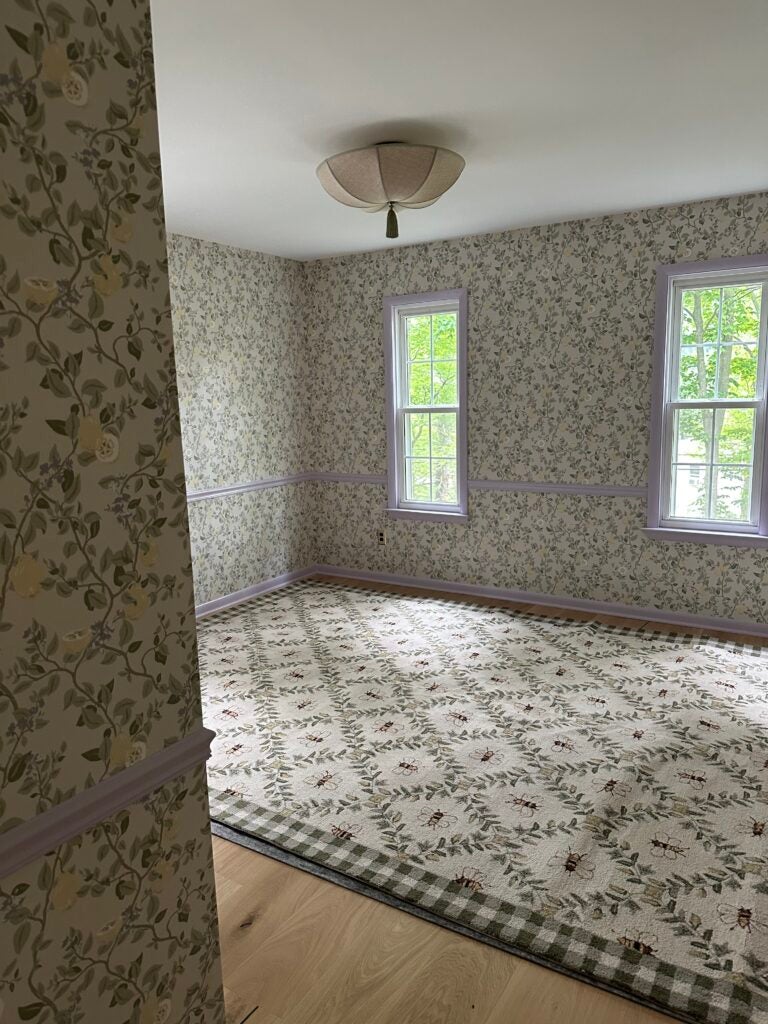
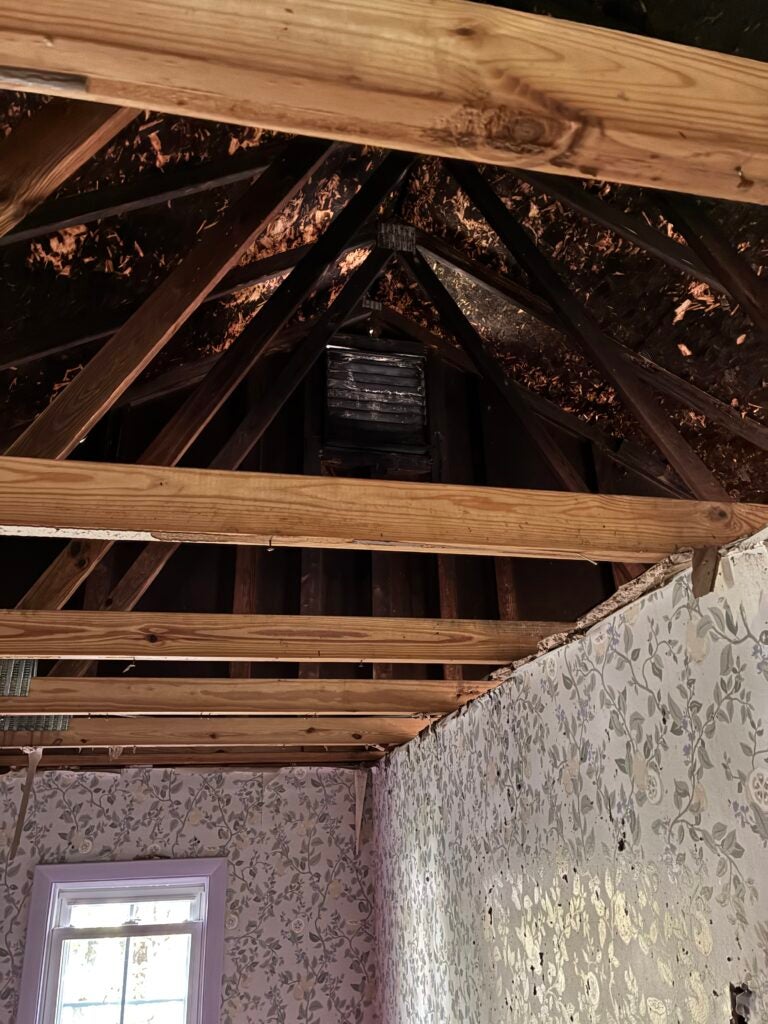
Before and after images of the Gershons’ living room, which featured custom wallpaper and upgraded finishes prior to the fire.
Many homeowners like Gershon elected to purchase extra coverage, like extended replacement costs or guaranteed replacement cost endorsements, which kick in once the dwelling limit is exhausted. Extended replacement can pay an additional 25% or 50% in addition to the dwelling limit, and guaranteed replacement pays the full cost to rebuild your home after a disaster.
However, these endorsements often come with policy provisions requiring homeowners to allow the carrier to keep the inflation guard in place. Carriers may also require that they be notified of any alterations to the home that could increase rebuilding costs.
“Some policies spell out that you must notify the insurer if you do a remodel that costs more than a set amount,” says Bach. In general, United Policyholders recommends an annual insurance check-up to fine-tune limits.
How to strengthen your insurance safety net
Homebuyers scrutinize mortgage rates and loan terms down to the decimal point, yet many rely on others to make decisions about their insurance coverage. “There are so many things in life to know and worry about,” Gershon says. “It’s easy to just trust the professionals and assume you’re covered.”
But each of those professionals has their own priorities. Lenders want to protect the loan. Real estate agents want to sell the house. Agents have to balance coverage with underwriting guidelines and what the buyer is willing to pay. With home insurance costs averaging $2,424 per year and rising, price matters — but coverage matters more. Saving on premiums won’t mean much if the policy falls short when disaster strikes.
How to reduce your chances of being underinsured
While no policy can eliminate every risk, experts say homeowners can take practical steps to reduce their chances of being underinsured.
- Get multiple rebuilding cost estimates to ensure the dwelling cost and the true rebuilding costs are aligned. “When we bought our current house, the insurance company sent someone to estimate the replacement cost. I also hired someone independently for about $300 to do the same thing, and I asked a friend who’s a homebuilder to give me a ballpark figure.” – Bill Wilson, CPCU, ARM, AIM, AAM
- Inquire about additional dwelling coverage, such as extended or increased replacement cost or guaranteed replacement cost. “A guaranteed replacement cost endorsement is a premium feature that some property insurers offer. It protects against surging construction costs for labor and materials after major disasters and prevents coverage shortfalls. It typically adds about 5%-10% to your total premium for the policy.” – Mark Friedlander, Senior director of corporate communications, Insurance Information Institute
- Have your adjuster and contractor work together after a major loss. “If the estimates are far apart, it’s best to have the carrier’s adjustor and the contractor walk the house together to arrive at an agreed scope. If everyone is looking at the same damage at the same time, it’s easier to reconcile the estimate.” – Chantal M. Roberts, CPCU, AIC, RPA, ITP, insurance claims expert and educator
- Compare dwelling limits and premiums when shopping for a better rate. “The most price-sensitive consumers (those who switch insurers at least once after purchasing their home) exhibit the greatest coverage neglect–they focus narrowly on quoted premiums when shopping for new policies. Policyholders may leave money on the table by not shopping for the best rate for their chosen level of coverage.” – J. Anthony Cookson, Emily Gallager, and Philip Mulder (2024, December 16) Coverage Neglect in Homeowners Insurance. CU Boulder Today
Homeowners insurance is designed to share the financial risk of loss, yet it depends on several factors working together to do so effectively. Not only must homeowners maintain adequate coverage, but they also have to understand what their policies actually provide and have enough savings or access to funds to navigate the claims process.
It also depends on trust that the carrier will honor the promises outlined in the contract.
In most cases, claims are resolved without major dispute. But when what a homeowner expects and what a policy ultimately pays don’t align, policyholders may need to seek additional guidance from contractors, public adjusters or legal professionals to ensure the coverage they purchased performs as intended.
“I recognize how privileged we are,” Gershon says. “This is financially stressful, but it’s not going to ruin us. We’re educated, we have flexible jobs, and we have the time and confidence to advocate for ourselves. But if it’s this hard for us, I can’t imagine how hard it is for someone who doesn’t have those advantages. That’s why I’m sharing our story, I hope it helps other homeowners understand what they’re walking into.”
Did you find this page helpful?
Why we ask for feedback Your feedback helps us improve our content and services. It takes less than a minute to complete.
Your responses are anonymous and will only be used for improving our website.
Help us improve our content
Thank you for your feedback!
Your input helps us improve our content and services.
Read the full article here
Confusing policy language, rising construction costs and lengthy claim resolution timelines can leave families scrambling — even when they thought they were fully covered.
“It looks like a dollhouse,” says Emily Gershon, about her Maryland home. “From the front, it looks fine. But then the whole back of the house and the roof are just gone.”
On a crisp October day, Gershon and her husband were clearing limbs and burning leaves — a routine fall chore across the Northeast. They weren’t reckless, says Gershon. “We’re the people who look up the county codes ahead of time. Is there a certain time of year? Does it have to be a specific distance from the house? What does the ground need to be like?”
As they worked, a small fire scorched the side of their home, which they were able to put out quickly. At first, the damage appeared minimal. But after extinguishing the flames, they looked up and saw smoke billowing from the chimney.
The fire chief called it a “freak accident.” Somehow, embers had gotten caught between the vinyl siding and sheathing of the house, spreading the fire across the attic.
Gershon and her husband were able to get their two young children to safety, but in the weeks that followed, they faced a different kind of challenge: a massive chasm between their insurance policy’s promises and the reality of rebuilding.
When coverage and costs diverge
After the fire, Gershon and her husband began the process of compiling estimates to rebuild her home. The local fire department estimated the damage at roughly $750,000. An architect’s feasibility study estimated a rebuild cost between $600,000 and $900,000. The insurance company’s number? Approximately $258,000 in actual cash value, with a replacement cost value in the low $300,000s.
For Gershon, the discrepancy was jarring. Her homeowners insurance policy listed $500,000 in dwelling coverage and a 25% extended coverage endorsement.
Seeking clarity, the Gershons hired a seasoned restoration contractor — a former insurance agent with decades of experience. His initial estimate for the basement, first floor, roof and exterior totaled about $383,000. But because his estimate excluded the second floor, screened-in porch and landscaping, that sum still wouldn’t fully restore the home to its pre-loss condition.
As of this writing, Gerson’s claim remains ongoing — and it’s possible these valuations may shift as the process continues. But the question remains: How can discrepancies on this scale emerge, even when homeowners believe they’ve done everything right?
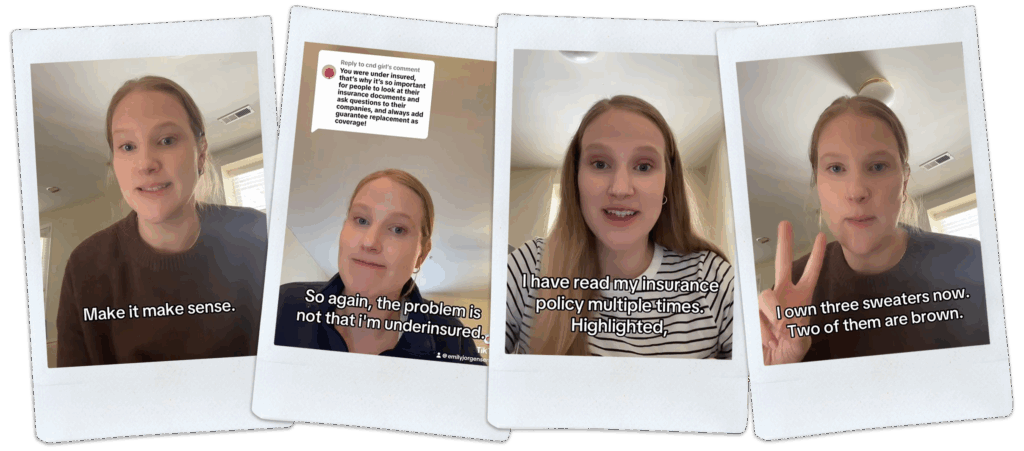
“When you look at the policy, it feels like the coverage is there,” she says. “But then you get a number that doesn’t reflect what it actually costs to rebuild, and it just doesn’t make sense.





Compare rates and save on home insurance today!
How replacement cost coverage can go wrong
In situations like the Gershons’, coverage conflicts can arise from a combination of factors — from differences in rebuild estimates to policy limitations, valuation methods and claim procedures.
Insurers control the claims process — and the language of the policy itself — creating an inherent power imbalance between the company and the policyholder. Homeowners who receive less than they believe their policy promises can feel like the carrier is being dishonest or that they’re operating in bad faith.
However, the legal standard for bad faith is much higher than a simple dispute over a claim payment. Courts generally look for evidence that the insurer intentionally or recklessly failed to investigate, communicate or settle a claim fairly.
Gershon isn’t ready to say the situation has reached that point yet, and says she’s surprised by how quickly people suggest bringing in outside help. “People kept telling us to get a lawyer or a public adjuster,” Gershon says. “And I kept thinking, why should I have to hire someone just to enforce a legally binding contract? That shouldn’t be the first step homeowners feel they have to take just to get their insurer to do what the policy says.”
While bad faith requires clear evidence of unfair conduct, many disputes arise from more complicated forces. Challenges with estimating software, rising construction costs, depreciation holdbacks and confusing rebuild estimates can all contribute to gaps between what a homeowner expects and what an insurer initially pays.
Generic estimating software and inflation leave homeowners underinsured
Many policies rely on an inflation guard endorsement to help prevent coverage limits from lagging behind construction inflation. “It automatically increases a homeowner’s dwelling and personal property limits annually to keep pace with rising construction material and labor costs,” says Mark Friedlander, senior director of media relations for the Insurance Information Institute. “This protects against underinsurance and ensures the policyholder has adequate replacement cost coverage for repairing or rebuilding their home following a covered loss.”
But construction costs have been anything but predictable over the past several years. While inflation peaked at 9.1% in June 2022, construction costs are still volatile. Prices for residential building materials and labor rose sharply between 2020 and 2022; in some cases, far outpacing the average 2% to 4% annual inflation guard adjustment.
When rebuilding costs outpace policy limit adjustments, the result isn’t just confusion — it can also mean significant underinsurance.
Consumer advocates say that gap can be compounded by the way some dwelling limits are calculated.
“The heart of the problem is that insurers are continuing to use estimating software to set dwelling limits that are not realistic to current prices in areas where urban conflagrations are occurring, such as Boulder and Los Angeles. Inflation guard provisions very rarely generate enough extra protection to fill underinsurance gaps.”— Amy Bach, Co-founder, United Policyholders
In recent cases studied by United Policyholders, Bach says homes insured for under $400 per square foot faced rebuilding costs closer to $850 per square foot. “And that’s on the low end of the gaps people have.”
It’s estimated that about two-thirds of U.S. carriers use the software program 360Value to estimate dwelling limits on home insurance policies, and their adjusters use the Xactimate program to estimate rebuilding costs after a loss. Both estimating tools are owned by Verisk, an insurance analytics firm.
Marshall Fire homeowners shorted $139K on average
A 2024 study by the University of Colorado at Boulder found that, of the 4,859 policyholders impacted by the Marshall Fire in 2021, 74% were underinsured. The study noted that third-party estimation software used by carriers to set policy limits often underestimated rebuild costs, causing homeowners to not have enough coverage. On average, homeowners were shorted $139,000.
Policy language and limited cash flow present additional hurdles for homeowners
Policy language can also add to homeowners’ confusion, particularly when it comes to the difference between actual cash value (ACV) and replacement cost value (RCV). ACV reflects what an item or structure was worth at the time of the loss after accounting for depreciation. Some policies pay only ACV, meaning the depreciated value is never recovered.
Replacement cost policies work differently, but not always in the way homeowners expect. Even with RCV coverage, insurers typically issue an initial payment based on ACV. The remaining amount — often called the depreciation holdback — is paid only after repairs are completed and receipts are submitted.
Replacement cost payout equation
Replacement cost policies often issue a smaller first payment, with the remaining funds paid after repairs are completed and documented. The following is a simplified example of the process for a home with $500,000 in dwelling coverage needing $400,000 in repairs.
$400,000 repair cost − $120,000 depreciation (30%) − $2,000 deductible = $278,000 initial payment
This leaves $120,000 in depreciation holdback, which is paid after repairs are completed.
Keep in mind that depreciation is sometimes applied line-by-line to building components and not the entire house at once. This means the holdback amount is calculated across many items, such as roof, siding, flooring, etc and can range from modest to substantial.
In these cases, the issue isn’t a lack of coverage but a lack of liquidity. Because replacement cost benefits and certain endorsements are often paid in stages or through reimbursement, homeowners may need access to savings, credit or other funds to begin repairs before receiving the full value of their claim. Additional living expense payments may also be reimbursed monthly rather than provided upfront.
That can be a challenge for many households. Bankrate’s 2026 Annual Emergency Savings Report found that only 47% of Americans say they have enough accessible funds to cover a $1,000 emergency expense.
“I completely underestimated what it would cost just to replace basic things,” Gershon says. “The night of the fire, while the trucks were still outside, I was on my phone ordering toothpaste, contact solution, underwear, socks. We have a baby and a toddler. I was just trying to get us to the next morning. It was $1,000.”
Some homeowners turn to assignment-of-benefits agreements, which allow contractors to receive insurance payments directly in exchange for starting repairs. But those arrangements have faced growing scrutiny.
“Assignment of benefits provisions allow consumers who are cash-strapped to assign their insurance funds to a roofer or contractor so they can get started with necessary work,” says Bach. “But there’s been so much abuse of those provisions, they’ve been outlawed in Florida, and other states, including Washington, are considering similar restrictions.”
Insurance jargon, decoded
Key terms to know
- Assignment of benefits agreement (AOB): Allows a homeowner to transfer their insurance claim rights to a contractor or repair company, giving that third party the authority to negotiate with the insurer and collect payment directly.
- Actual cash value (ACV): The value of damaged property at the time of loss after depreciation for age, wear and tear and consideration for its expected useful life.
- Depreciation holdback: The portion of a replacement cost claim that insurers withhold until repairs are completed. Once the homeowner provides proof of repair, the insurer releases the withheld amount.
- Extended replacement cost endorsement: A home insurance endorsement that increases the dwelling limit of your policy if your rebuilding cost exceeds the policy limit (typically between 10% – 25%).
- Feasibility study: An assessment by an architect or construction professional that uses current market construction costs to estimate the rebuild cost of the home, including current finishes and code considerations.
- Guaranteed replacement cost endorsement: A home insurance endorsement that requires your insurer to pay the full cost to rebuild or repair your home after a covered claim. This coverage removes the cap tied to the policy limit.
- Replacement cost value (RCV): The amount it costs to repair or replace damaged property with new materials of similar kind and quality, without deducting depreciation.
Undisclosed home improvements can erode enhanced coverage
Beyond policy mechanics and cash flow challenges, another factor can widen the gap between coverage and rebuilding costs: home improvements that were never reported to the insurer. While homeowners often update their policy after major renovations, smaller upgrades can accumulate over time and significantly increase a home’s rebuild value.
Gershon discovered this when insurers began estimating the value of her home’s finishes. The insurer’s initial estimate allowed roughly $1,500 for wallpaper throughout the home. “The wallpaper in our daughter’s room alone costs that much in materials,” she says. The same issue appeared in allowances for upgraded light switches and hardware.
Gershon acknowledges she didn’t notify her carrier of those incremental upgrades at the time, noting that, “none of our individual upgrades cost $25,000.” Still, she expected those differences to be visible during inspection.
Before and after images of the Gershons’ living room, which featured custom wallpaper and upgraded finishes prior to the fire.
Many homeowners like Gershon elected to purchase extra coverage, like extended replacement costs or guaranteed replacement cost endorsements, which kick in once the dwelling limit is exhausted. Extended replacement can pay an additional 25% or 50% in addition to the dwelling limit, and guaranteed replacement pays the full cost to rebuild your home after a disaster.
However, these endorsements often come with policy provisions requiring homeowners to allow the carrier to keep the inflation guard in place. Carriers may also require that they be notified of any alterations to the home that could increase rebuilding costs.
“Some policies spell out that you must notify the insurer if you do a remodel that costs more than a set amount,” says Bach. In general, United Policyholders recommends an annual insurance check-up to fine-tune limits.
How to strengthen your insurance safety net
Homebuyers scrutinize mortgage rates and loan terms down to the decimal point, yet many rely on others to make decisions about their insurance coverage. “There are so many things in life to know and worry about,” Gershon says. “It’s easy to just trust the professionals and assume you’re covered.”
But each of those professionals has their own priorities. Lenders want to protect the loan. Real estate agents want to sell the house. Agents have to balance coverage with underwriting guidelines and what the buyer is willing to pay. With home insurance costs averaging $2,424 per year and rising, price matters — but coverage matters more. Saving on premiums won’t mean much if the policy falls short when disaster strikes.
How to reduce your chances of being underinsured
While no policy can eliminate every risk, experts say homeowners can take practical steps to reduce their chances of being underinsured.
- Get multiple rebuilding cost estimates to ensure the dwelling cost and the true rebuilding costs are aligned. “When we bought our current house, the insurance company sent someone to estimate the replacement cost. I also hired someone independently for about $300 to do the same thing, and I asked a friend who’s a homebuilder to give me a ballpark figure.” – Bill Wilson, CPCU, ARM, AIM, AAM
- Inquire about additional dwelling coverage, such as extended or increased replacement cost or guaranteed replacement cost. “A guaranteed replacement cost endorsement is a premium feature that some property insurers offer. It protects against surging construction costs for labor and materials after major disasters and prevents coverage shortfalls. It typically adds about 5%-10% to your total premium for the policy.” – Mark Friedlander, Senior director of corporate communications, Insurance Information Institute
- Have your adjuster and contractor work together after a major loss. “If the estimates are far apart, it’s best to have the carrier’s adjustor and the contractor walk the house together to arrive at an agreed scope. If everyone is looking at the same damage at the same time, it’s easier to reconcile the estimate.” – Chantal M. Roberts, CPCU, AIC, RPA, ITP, insurance claims expert and educator
- Compare dwelling limits and premiums when shopping for a better rate. “The most price-sensitive consumers (those who switch insurers at least once after purchasing their home) exhibit the greatest coverage neglect–they focus narrowly on quoted premiums when shopping for new policies. Policyholders may leave money on the table by not shopping for the best rate for their chosen level of coverage.” – J. Anthony Cookson, Emily Gallager, and Philip Mulder (2024, December 16) Coverage Neglect in Homeowners Insurance. CU Boulder Today
Homeowners insurance is designed to share the financial risk of loss, yet it depends on several factors working together to do so effectively. Not only must homeowners maintain adequate coverage, but they also have to understand what their policies actually provide and have enough savings or access to funds to navigate the claims process.
It also depends on trust that the carrier will honor the promises outlined in the contract.
In most cases, claims are resolved without major dispute. But when what a homeowner expects and what a policy ultimately pays don’t align, policyholders may need to seek additional guidance from contractors, public adjusters or legal professionals to ensure the coverage they purchased performs as intended.
“I recognize how privileged we are,” Gershon says. “This is financially stressful, but it’s not going to ruin us. We’re educated, we have flexible jobs, and we have the time and confidence to advocate for ourselves. But if it’s this hard for us, I can’t imagine how hard it is for someone who doesn’t have those advantages. That’s why I’m sharing our story, I hope it helps other homeowners understand what they’re walking into.”
Did you find this page helpful?
Why we ask for feedback Your feedback helps us improve our content and services. It takes less than a minute to complete.
Your responses are anonymous and will only be used for improving our website.
Help us improve our content
Thank you for your feedback!
Your input helps us improve our content and services.
Read the full article here
Related Articles